Hallmarking — the marks, the law and the exemption weights
Hallmarking is criminal law in the United Kingdom, not a courtesy. This page reproduces the Dealer’s Notice we are required to display, explains how to read the marks struck on our pieces, and lists which items in this shop carry a hallmark and which are lawfully below the exemption weight.
Last updated 12 August 2026
Dealer’s Notice — displayed as required by the Hallmarking Act 1973
UK Hallmarks
It is an offence for any person in the course of a trade or business to apply to an unhallmarked article a description indicating that it is wholly or partly made of gold, silver, platinum or palladium, or to supply unhallmarked articles to which such a description is applied.
A UK hallmark consists of three compulsory marks: the sponsor’s or maker’s mark, the millesimal fineness mark showing the precious metal content in parts per thousand, and the assay office mark showing where the article was tested and marked. Optional marks may also appear: the traditional fineness symbol, the date letter and, on articles marked under the international convention, the common control mark.
The exemption weights
Articles below the following weights are exempt from compulsory hallmarking:
- Gold
- 1 g
- Silver
- 7.78 g
- Platinum
- 0.5 g
- Palladium
- 1 g
The UK Assay Offices are London (town mark: leopard’s head), Birmingham (anchor), Sheffield (rose) and Edinburgh (castle). Every hallmarked article in this shop is marked at London.
How to read the mark on your piece
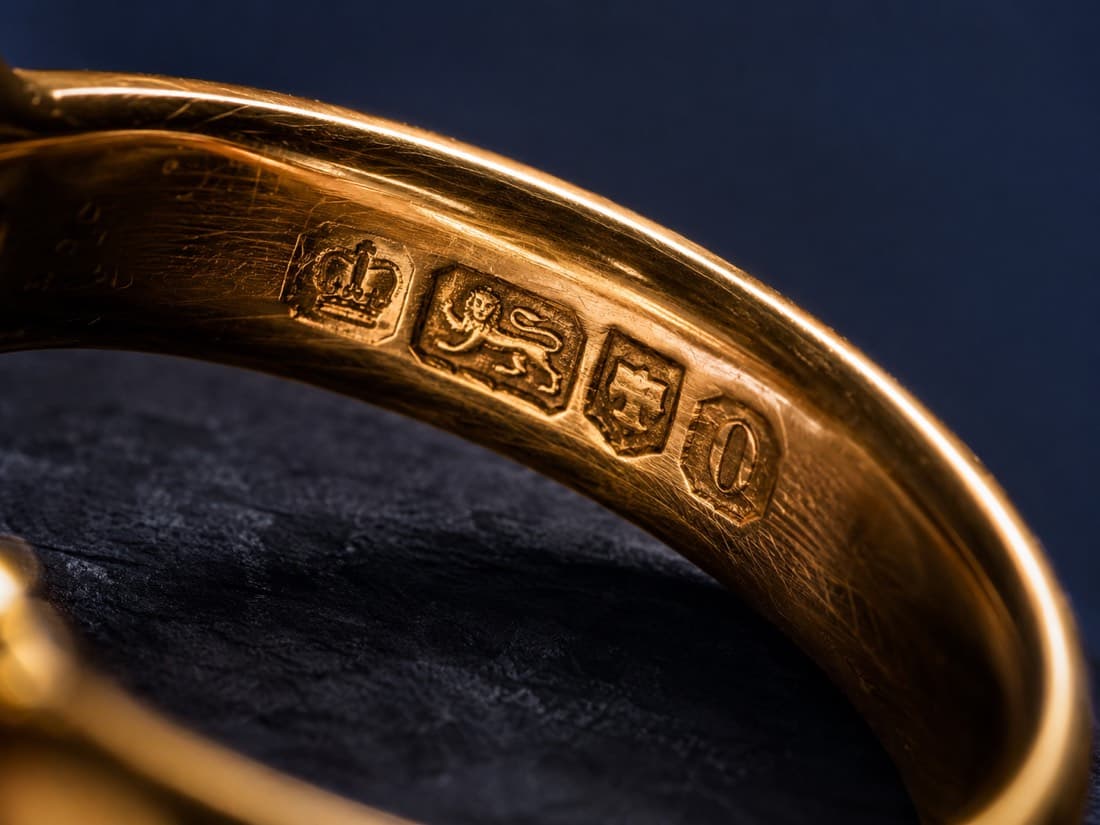
Read the marks left to right. On our pieces you will find three:
- Sponsor’s mark — the registered mark of the party that submitted the article for assay. It identifies who is responsible for the article, not who made it.
- Millesimal fineness — the precious metal content in parts per thousand, inside a shaped surround that indicates the metal. 925 in an oval is sterling silver. 375 in a rectangle with clipped corners is 9 carat gold.
- Assay office town mark — a leopard’s head for London.
Millesimal fineness, by metal
| Metal | Standards | Used in this shop |
|---|---|---|
| Silver | 800, 925, 958, 999 | 925 — sterling |
| Gold | 375, 585, 750, 916, 990, 999 | 375 — 9 carat |
| Platinum | 850, 900, 950, 999 | Not currently stocked |
| Palladium | 500, 950, 999 | Not currently stocked |
What we do about the exemption weights
Being under an exemption weight is lawful and common — a 2 g silver pendant does not need a mark. What is not acceptable is leaving you unable to tell which situation you are in. So every product page states the net metal weight in grams and says, in words, either that the article is hallmarked and where, or that it falls below the statutory exemption for its metal and is therefore unmarked.
There is also a guard in the code behind this shop. Before any item is rendered, its net metal weight is checked against the exemption for its metal type. If an article is over the limit and carries no hallmark, it is not displayed and cannot be bought — it does not appear in the catalogue, in search or on a direct link. That check runs on every page load rather than being a step someone has to remember.
Which pieces carry a mark
Hallmarked at the London Assay Office — 9 pieces
- Garnet Band Ring 5 mm — 9ct Gold — 2.10 g of 9ct yellow gold, over the 1 g exemption
- Amethyst Cocktail Ring 10 mm — 8.40 g of 925 sterling silver, over the 7.78 g exemption
- Aquamarine Stud Pair 5 mm — 9ct Gold — 1.40 g of 9ct yellow gold, over the 1 g exemption
- Lab-Grown Diamond Pendant 0.25 ct — 9ct Gold — 1.60 g of 9ct yellow gold, over the 1 g exemption
- Lab-Grown Diamond Stud Pair 0.20 ct TCW — 9ct Gold — 1.20 g of 9ct yellow gold, over the 1 g exemption
- Emerald Stud Pair 4 mm — 9ct Gold — 1.50 g of 9ct yellow gold, over the 1 g exemption
- Blue Sapphire Stud Pair 4 mm — 9ct Gold — 1.30 g of 9ct yellow gold, over the 1 g exemption
- Blue Sapphire Band Ring — 9ct Gold — 2.80 g of 9ct yellow gold, over the 1 g exemption
- Citrine Cocktail Ring 10 mm — 8.90 g of 925 sterling silver, over the 7.78 g exemption
Below the exemption weight, lawfully unmarked — 34 pieces
These are solid metal at the fineness stated. The exemption concerns marking, not the alloy.
- Garnet Solitaire Pendant 6 mm — 2.10 g
- Garnet Stud Pair 4 mm — 1.10 g
- Amethyst Oval Pendant 8×6 mm — 2.60 g
- Amethyst Drop Earrings — 3.40 g
- Aquamarine Pendant 7×5 mm — 2.40 g
- Aquamarine Bar Necklace — 4.20 g
- White Sapphire Stud Pair 4 mm — 1.20 g
- White Topaz Pendant 6 mm — 2.00 g
- Emerald Pendant 6×4 mm — 2.30 g
- Lab-Created Emerald Ring 7×5 mm — 4.60 g
- Cultured Pearl Stud Pair 7 mm — 1.40 g
- Cultured Pearl Pendant 9 mm — 1.80 g
- Moonstone Cabochon Pendant 8 mm — 2.50 g
- Moonstone Cabochon Ring 10 mm — 5.20 g
- Ruby Solitaire Pendant 5 mm — 2.20 g
- Ruby Stud Pair 3.5 mm — 9ct Gold — 0.86 g
- Lab-Created Ruby Ring 7 mm — 5.40 g
- Peridot Pendant 7 mm — 2.40 g
- Peridot Stud Pair 5 mm — 1.30 g
- Peridot Trilogy Ring — 5.80 g
- Blue Sapphire Pendant 5 mm — 2.20 g
- Opal Cabochon Pendant 8×6 mm — 2.60 g
- Pink Tourmaline Pendant 6 mm — 2.30 g
- Opal Stud Pair 5 mm — 1.50 g
- Citrine Pendant 8×6 mm — 2.50 g
- Blue Topaz Pendant 8 mm — 2.70 g
- Tanzanite Pendant 6×4 mm — 2.30 g
- Turquoise Cabochon Ring 10 mm — 5.60 g
- Blue Zircon Pendant 6 mm — 2.40 g
- Family Birthstone Pendant — three stones — 3.10 g
- Rainbow Bar Necklace — five stones — 4.80 g
- Two-Stone Toi et Moi Ring — 5.10 g
- Raw Crystal Point Pendant — 1.90 g
- Agate Slice Cabochon Pendant — 3.60 g
Plating is not fineness
A hallmark describes the metal of the article, not a coating on it. Where a piece is plated we say so in the declaration block and we use the correct term for the process — see the metal section of the declarations page. No plated item is described as solid gold anywhere on this site, and we do not use the word vermeil for a gold layer thinner than 2.5 microns.
Where to check for yourself
The four UK Assay Offices publish guidance on reading marks, and the British Hallmarking Council oversees the system. If you want a piece independently checked, any UK assay office will do it. If a mark on something we sold you does not read as this page describes, write to us and we will take the item back and investigate — see complaints.