Gem declarations — every word on this site, defined
This is the page the rest of the shop refers back to. It defines every term used in the declaration block on a product page, explains the seven treatments we disclose and what each one means for cleaning, sets out the hardness scale and our three wear grades, and states plainly what this shop will never say about a stone.
Last updated 12 August 2026
Natural, lab-created, cultured, imitation
These four words do specific work, and we use them in only one way each. We never use “real”, “genuine” or “authentic” to describe a stone, because those words do not distinguish between something formed in the earth and something grown in a reactor — they only sound like they do.
| Term | What it means here |
|---|---|
| Natural | Formed in the earth. Cut and polished by people; the material itself is not made by people. |
| Lab-created (synthetic) | Grown in a laboratory. Chemically and optically the same material as its natural counterpart, made by people rather than found. |
| Cultured | Grown inside a living mollusc after a deliberate implant. Not a natural pearl; not an imitation. |
| Imitation | A different material that looks like the stone it stands in for. Named by what it actually is, never by the stone it resembles. |
Imitations are named as what they are
A material that merely looks like a gemstone is never given that gemstone’s name here. Cubic zirconia is called cubic zirconia. Glass is called glass. Synthetic spinel is called synthetic spinel. None of them is a diamond, a sapphire or an aquamarine, and none of them will be described on this site as though it were. Note that cubic zirconia — a manufactured material — is entirely unrelated to zircon, which is a natural mineral we do sell and label as such.
Pearls are described in three ways, not two
A natural pearl forms without human involvement and is extraordinarily rare. A cultured pearl is grown inside a living mollusc around a deliberate implant. An imitation pearl is a coated bead. Every pearl in this shop is cultured, and every pearl page says so.
We do not sort stones into first and second class
The Victorian habit of dividing gems into a privileged handful and everything else has no mineralogical basis and tells you nothing useful. What matters is species, hardness, toughness and treatment state — all of which are printed on the piece.
The seven treatments we disclose
The great majority of coloured stones on the world market have been treated in some way. That is not a scandal and it is not a secret in the trade — it is simply how coloured stones reach the counter, and it has been for centuries in the case of emerald. What is not acceptable is leaving the buyer to guess. Every stone in this shop declares its treatment state item by item, including when the answer is that nothing has been done to it.
| Treatment | What it is |
|---|---|
| Untreated | Cut and polished only. Nothing has been added to or done to this stone. |
| Heated | Controlled heating, applied to develop or even out colour. Stable and permanent under normal wear. This is the most common treatment in the coloured stone trade. |
| Fracture-filled | Surface-reaching fractures have been filled with oil, resin or glass to reduce their visibility. The filler is not permanent and dictates how the piece may be cleaned. |
| Irradiated | Exposed to radiation to change the colour, then heated to stabilise it. The resulting stone is not radioactive; the colour can shift under sustained heat or strong light. |
| Dyed | Colouring agent introduced into the stone. Sensitive to solvents and abrasion. |
| Coated | A thin layer applied over the surface to alter colour or lustre. It can wear through. |
| Diffusion | Colour introduced into the surface layer at high temperature. Recutting or heavy repolishing can remove it. |
| Stabilised | A porous stone impregnated with resin so it can be cut and worn. Standard practice for this species and disclosed here on every affected piece. |
Treatment decides how a piece may be cleaned
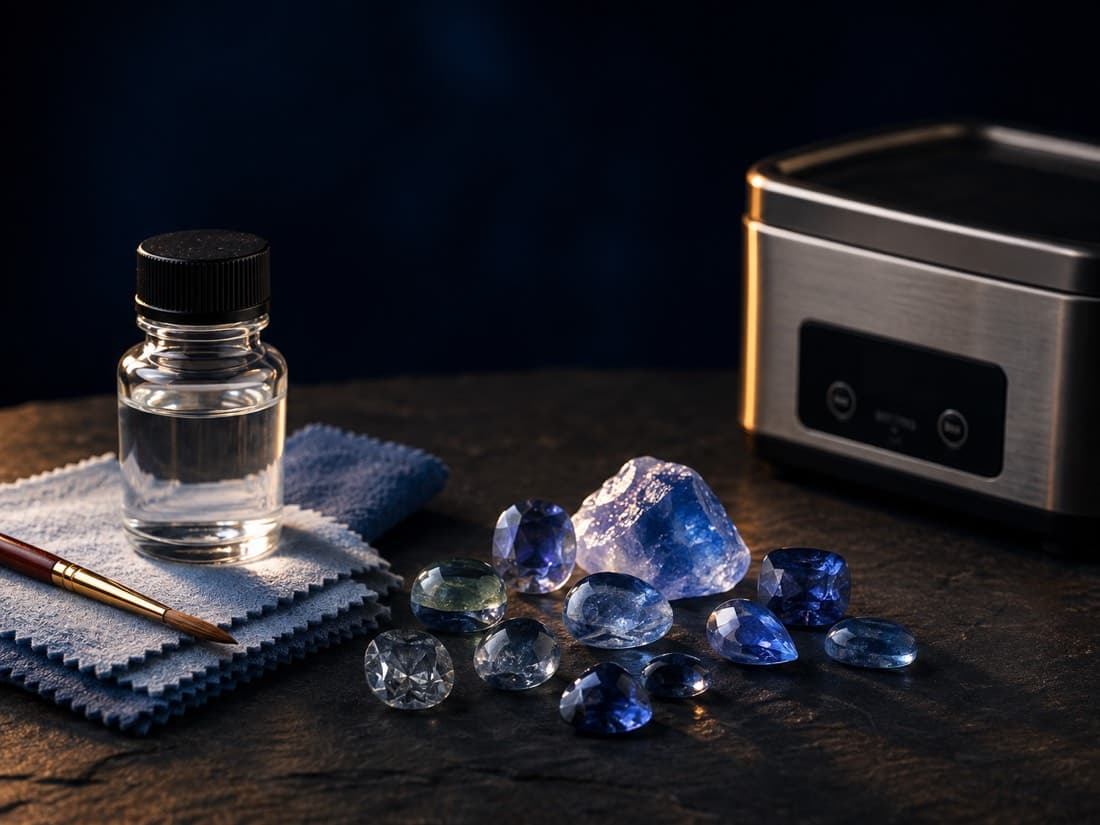
This is the practical reason disclosure matters. A fracture-filled emerald put through an ultrasonic tank can come out with the filler driven out of the fractures and the stone looking far worse than it did going in. Stabilised turquoise meeting a solvent can lift. Irradiated topaz left in sustained heat or strong light can shift colour. Our product pages derive their cleaning limits directly from the declared treatments and the porosity of the species, so the warning cannot be left off by accident.
Hardness, toughness and our three wear grades
The Mohs scale ranks minerals by which one scratches which. It is ordinal, not linear: diamond at 10 is many times harder than corundum at 9, not ten per cent harder. It also says nothing about toughness — resistance to breaking — which is a separate property governed largely by cleavage and internal fractures.
Ordinary household dust is largely quartz, at Mohs 7. That single fact explains most of what goes wrong with coloured stone jewellery: anything below 7 will gradually dull if it is wiped, rubbed or stored loose against other pieces.
Every piece here carries one of three wear grades, and each grade is a statement about what to avoid rather than a promise about durability:
- Suitable for daily wear — Mohs 8 and above with no problematic cleavage. In this catalogue that means corundum and diamond only.
- Occasional wear, avoid knocks — worn for evenings and weekends, removed for anything physical.
- Delicate, special occasions only — worn a few times a year, stored carefully in between, kept away from cosmetics and temperature swings.
We do not make blanket statements about wear resistance on any piece. No jeweller can honestly promise that a stone will not mark, and we will not imply it.
| Species | Mohs | Wear grade | The specific risk |
|---|---|---|---|
| Pearl | 2.5 – 4.5 | Delicate | Softer than household dust. Store separately; no ultrasonic, no steam, no soaking. |
| Turquoise | 5 – 6 | Delicate | Porous. Keep away from solvents, cosmetics and perfume; never soak. |
| Opal | 5.5 – 6.5 | Delicate | Holds structural water. Avoid dry heat, direct sun for long periods and sudden temperature change. |
| Moonstone | 6 | Delicate | Two directions of perfect cleavage. A knock in the wrong plane will split it. |
| Tanzanite | 6 – 7 | Occasional | One perfect cleavage plane. No ultrasonic. |
| Peridot | 6.5 – 7 | Occasional | Sensitive to acids and thermal shock. Never steam. |
| Agate | 6.5 – 7 | Occasional | Robust as a material; thin slices are fragile at the edge. |
| Quartz — amethyst, citrine, rock crystal | 7 | Occasional | Prolonged strong sunlight can fade amethyst. |
| Garnet | 7 – 7.5 | Occasional | Will scuff against harder stones. Do not stack. |
| Tourmaline | 7 – 7.5 | Occasional | Pyroelectric — attracts dust when warm. |
| Zircon | 7.5 | Occasional | Facet edges abrade more readily than corundum. |
| Emerald | 7.5 – 8 | Occasional | Hardness is misleading: the internal fracture network makes it fragile. |
| Aquamarine | 7.5 – 8 | Occasional | One direction of imperfect cleavage. |
| Topaz | 8 | Occasional | Perfect basal cleavage. Hard, but not tough. |
| Sapphire and ruby — corundum | 9 | Daily | No cleavage. The most forgiving material in this catalogue. |
| Diamond | 10 | Daily | Hardest natural material. Still chips on the girdle if struck hard. |
Carat, total carat weight and millimetre size
One carat is 0.2 grams. It is a measure of weight, not of size — a dense stone and a light one of the same carat weight will look very different set. That is why every piece here gives millimetre dimensions alongside the carat figure.
Where a piece holds more than one stone, we give the total carat weight, marked TCW, and we say so explicitly next to the number. A 1.85 ct TCW trilogy ring does not have a 1.85 ct centre stone, and stating only the total without labelling it is one of the commonest ways a description misleads without technically lying. Where it is useful we give the centre stone weight separately as well.
Metal, hallmarks and plating
Every piece states its metal, its millesimal fineness, its net metal weight in grams and its hallmark status. Plating terms are used strictly: gold-plated is a thin electroplated layer; gold-filled is a mechanically bonded layer of defined proportion; vermeil is sterling silver with a gold layer of at least 2.5 microns, and we will not use the word below that thickness; gold-tone is a base metal finish with no gold content at all. A plated item is never described as solid gold on this site. The hallmarking page explains the marks and the statutory exemption weights in detail.
Nickel, lead and cadmium
Items that pass through a piercing are tested against the UK REACH nickel release limit of 0.2 µg/cm² per week for post assemblies. Items in prolonged contact with skin are tested against the 0.5 µg/cm² per week limit. Lead content is held below 0.05 % and cadmium below 0.01 %.
Where we describe an item in these terms we say nickel-safe, tested to UK REACH limits and nothing more. We never describe any item as suitable for every skin, because no material is, and a reaction to a piece of jewellery can have causes that have nothing to do with its metal.
Materials this shop does not sell
We do not sell coral, tortoiseshell or giant clam, all of which are controlled under CITES. We do not sell elephant ivory, which is prohibited under the Ivory Act 2018. We do not stock lead-glass-filled ruby, beryllium-diffused sapphire, or opal doublets and triplets sold as solid opal.
What this shop will never say about a stone
We make no statement about the effect of any stone on health, mood, sleep, calm, fortune, wealth, protection, relationships or wellbeing of any kind. Not directly. Not by implication. And never in the hedged phrasing used to have it both ways: never “is said to”, never “traditionally believed to”, never “legend has it”. A claim wrapped in a disclaimer is still a claim, and under the UK Code of Non-broadcast Advertising it is treated as one.
This is not a marketing position. It is a hard rule enforced in three places:
- At build time, a filter scans every product description, month page and guide on this site against a list of prohibited terms. A single match stops the build. The site cannot be published with that copy on it.
- At render time, the same filter runs over customer reviews before they reach the page. A review is advertising in law, so a review describing an effect is held for moderation and is not published — we may edit the offending passage out, or decline the review entirely.
- In the enquiry forms, which state on their face that we do not offer readings or guidance on wellbeing or fortune, and which flag any such request so that our reply does not repeat one back.
What we will write about a stone is limited to two categories:
- Mineralogy — for example: sapphire is a variety of corundum, aluminium oxide, Mohs 9, coloured by iron and titanium.
- Documented, checkable history — for example: sapphire has held September on the modern birthstone list standardised in 1912. That is a fact about a published list, not a claim about a stone.
Jewellery, not an investment
Everything sold here is consumer jewellery, bought to be worn. Nothing on this site is offered as a financial product, a way to store value, or an asset expected to rise in price. We do not deal in bullion, we do not quote resale figures, and we do not make any statement about what a piece might be worth in future. If you are looking for an asset rather than something to wear, this is the wrong shop.
If we get something wrong
Declarations are made in good faith from supplier documentation and our own examination. If you believe a declaration on a piece you have bought is inaccurate, write to support@ishtarjewellery.shop with your order reference. We will re-examine the item, and where a description was wrong you are entitled to a remedy under the Consumer Rights Act 2015 — repair, replacement, or a refund — in addition to the ordinary right to change your mind. See returns and refunds and complaints.