A jewellery shop that prints what it knows
ISHTAR JEWELLERY LIMITED has been on the UK register since 2003 and sells watches and jewellery in specialised retail. Ishtar Stones is its coloured stone shop, and it exists to close a gap that runs through the whole trade: everything a buyer needs to know about a coloured stone is already known by the person selling it, and almost none of it reaches the tag.
What we sell
44 pieces of consumer jewellery: pendants, necklaces, stud and drop earrings, and rings, set with natural and laboratory-grown coloured stones, cultured pearls and lab-grown diamond. Metals are 925 sterling silver and solid 9 carat yellow gold. There is also one cleaning set. Prices run from £29 to £690, all including VAT.
The whole catalogue is organised by the twelve months of the modern birthstone list, standardised in 1912 and last extended in 2002. Three further lines cut across the months: multi-stone pieces, uncut and cabochon work, and care.
Everything is bought outright. There is no membership, no subscription box, no stored credit and no recurring charge anywhere on this site.
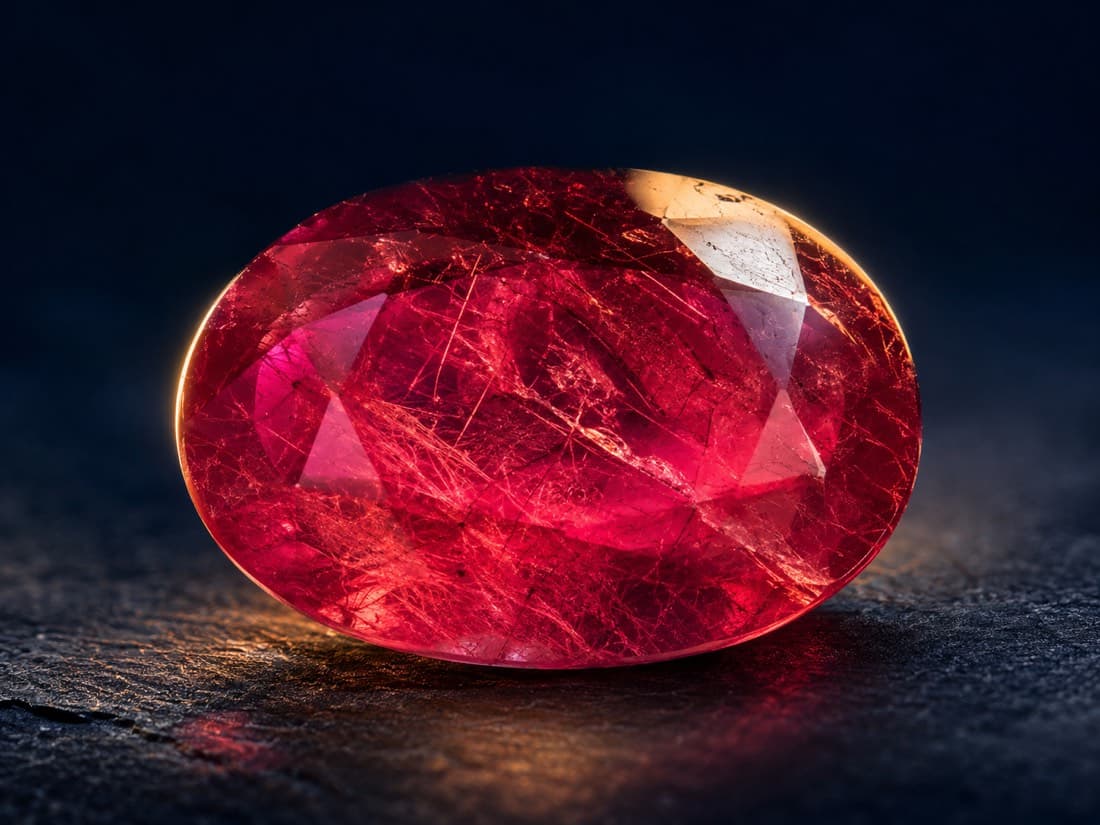
The inside of a natural ruby. Those needles are evidence of how the crystal grew — the trade calls it silk. We photograph stones as they are and do not retouch inclusions out.
The gap is not knowledge. It is disclosure.
Nearly all emerald sold anywhere has had its surface-reaching fractures filled. Most citrine began as amethyst in a kiln. The great majority of blue sapphire has been heated, often above 1600°C. Blue topaz is irradiated and then heated. Most turquoise is impregnated with resin so it can be cut at all. None of this is contested inside the trade, and none of it is wrong. It is how coloured stones reach a shop counter.
What is wrong is that a buyer usually finds out none of it. The tag says “emerald”. It does not say that putting it in the ultrasonic cleaner your jeweller sold you will drive the filler out of the fractures and leave it looking far worse than it did. That is not a gemmological problem. It is an information problem, and it is entirely fixable by printing what is already known.
So we print it. Every piece opens with a declaration block, before any of the persuasive copy: species, origin, every treatment listed one by one, carat and total carat weight, millimetre size, Mohs hardness, a wear grade in words with the specific things to avoid, metal fineness, net metal weight, hallmark status, and — where the item goes through a piercing — its nickel release compliance.
Where a piece would fail that standard, it does not go on sale. A stone missing any of origin, treatment, hardness or wear grade is not rendered. A precious metal article over its statutory exemption weight without a UK hallmark is not rendered. Those checks run in code on every page load, not on a checklist someone might forget.
The one thing we will not do
We say nothing about what a stone does. Because a stone does not do anything.
Coloured stone retail leans heavily on attributing effects — on mood, sleep, calm, fortune, protection, wellbeing. Some of it is sincere and some of it is marketing, and it is nearly always hedged: is said to, traditionally believed to, legend has it. Under the UK Code of Non-broadcast Advertising a claim in a disclaimer is still a claim.
We do not make those statements in any form. Not directly, not by implication, not hedged. It costs us a whole category of copy that reliably sells, and we have decided that is an acceptable price.
What we will write about a stone falls into two categories only: mineralogy — species, chemistry, hardness, optical behaviour — and documented, checkable history, such as which list a stone appears on and when that list was published.
The rule is enforced, not asserted. A filter runs at build time over every product description, month page and guide on this site; a single match stops the build and the site cannot be published. The same filter runs over customer reviews before they reach a page, because a review is advertising too — reviews that attribute an effect are held for a person to look at, and are not published as submitted.
Also worth stating plainly
- This is jewellery, not an investment.Nothing here is offered as a way to store value or as an asset expected to rise in price. We do not deal in bullion and we quote no resale figures.
- We do not sell restricted materials.No coral, tortoiseshell or giant clam, all controlled under CITES. No elephant ivory, prohibited by the Ivory Act 2018. No lead-glass-filled ruby, no beryllium-diffused sapphire, no assembled opal sold as solid.
- We describe skin safety narrowly.Nickel-safe, tested to UK REACH limits — and nothing beyond that, because no material suits every skin.
- We promise no durability.Every piece carries a wear grade and a list of things to avoid. None carries an open-ended guarantee, because no honest jeweller can give one.
Who you are dealing with
Legal entity
ISHTAR JEWELLERY LIMITED, a private limited company registered in England and Wales, trading as Ishtar Stones.
Registered and trading address
346 Kilburn Lane, London, W9 3EF, United Kingdom
Contact
support@ishtarjewellery.shop
+44 7196509962
Monday to Friday, 09:00–17:30 UK time
Governing law
England and Wales. Prices in pounds sterling, VAT included. See terms.